Problem
Lecture capture often stops at raw recordings, leaving transcription, summarization, storage, and retrieval fragmented across separate tools.
Project case study
AI transcription and summarization pipeline that converts spoken lectures into structured knowledge artifacts.
Project facts
Theme
Applied AI & Automation Systems
Current state
Research System
My role
Sole architect and pipeline engineer
Lecture capture often stops at raw recordings, leaving transcription, summarization, storage, and retrieval fragmented across separate tools.
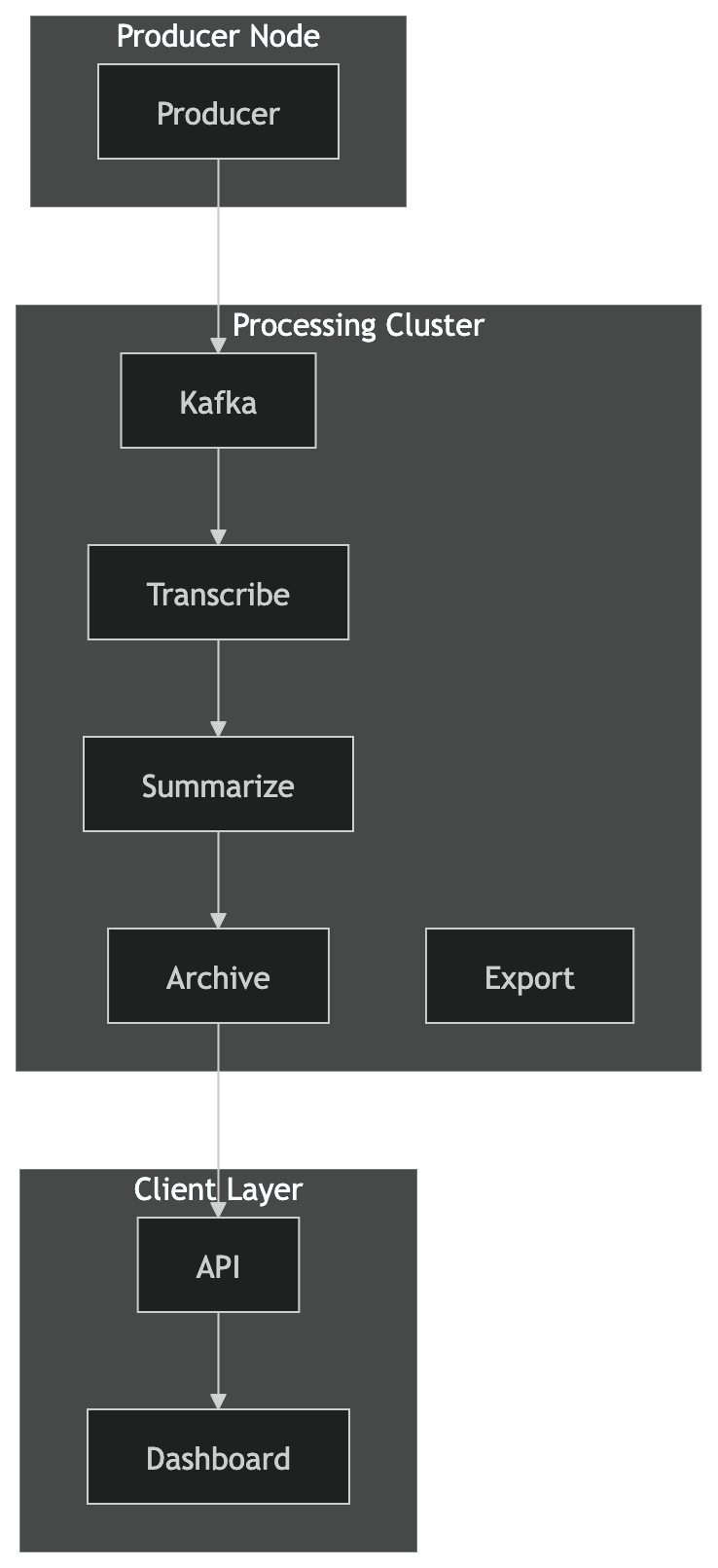
Event-driven decoupling: Kafka ensures transcription, summarization, and archival stages fail independently without data loss
End-to-end pipeline processing audio through transcription and summarization to structured artifacts
A concise problem → system → evidence structure so the engineering story is easier to inspect.
Built as an event-driven processing pipeline. Producer nodes upload audio into ingest services, Kafka fans work across transcription and summarization workers, archive services persist artifacts, and API/export layers expose transcripts and summaries as reusable outputs.
The system evidence is in the pipeline boundary diagram and the multi-stage processing model rather than a one-screen app demo.
Projects in a similar problem family.

AI-powered lead generation platform designed to automate prospect engagement workflows and move structured outcomes into sales operations.
My Role
Sole architect and full-stack engineer
Outcome
Architecture validated with working voice gateway, queue orchestration, and CRM integration layer; advancing toward pilot deployment

AI-assisted legal intake system that guides non-experts through complex legal situations with structured workflows and knowledge retrieval.
My Role
Sole architect and backend engineer
Outcome
Working prototype with policy-gated intake flow, jurisdiction detection, and conflict-check pipeline